
Views: 0 Author: Site Editor Publish Time: 2026-10-27 Origin: Site


Match power to dwell time: 60–120 kW suits retail, fleet depots and destinations where vehicles park 30–60 minutes; 150–240 kW is the sweet spot for highway plazas and turnkey charging hubs where every minute of occupancy costs money.
Connector strategy first: Confirm your market's plug standard (CCS1, CCS2, GB/T, NACS) before anything else — and prefer dual-gun cabinets, which double throughput per parking bay at modest incremental cost.
Grid capacity decides economics: Check transformer headroom and demand-charge tariffs early. Dynamic power distribution between two guns can deliver 240 kW of service on a smaller grid connection.
Budget realistically: Hardware is only 40–60% of project cost. Add installation, grid works, network fees and maintenance — total TCO over 5 years typically runs 1.8–2.5× the sticker price of the chargers.
Buy modular: A modular DC fast charger (e.g., 80–240 kW scalable architecture) lets you start smaller and add power modules as utilization grows, protecting cash flow without re-purchasing cabinets.
A DC fast charger (DCFC) converts AC grid power to DC inside the charging cabinet and feeds it directly to the vehicle's battery, bypassing the car's small onboard AC charger. That is why a DC unit can add 100–300 km of range in 10–30 minutes, while an 11 kW AC charger needs 5–8 hours for the same energy.
The trade-off is cost and complexity. A commercial 120 kW DC charger — including installation — commonly lands between $45,000 and $90,000, versus $1,500–$6,000 installed for a 7–22 kW AC unit. So the real buying question is not "which charger is best", but "does my site's traffic justify DC economics?"
Vehicles dwell under 45 minutes (highway, urban turnaround, taxi ranks, delivery hubs).
You operate turnkey fleet charging where vehicle uptime equals revenue.
You want to monetize fast charging as a retail draw — DC users spend 3–8× more per session than AC users.
Cars park overnight or all day (workplaces, hotels, residential).
Grid capacity is tight and upgrades are expensive — a bank of 22 kW AC chargers may serve more cars per day than one underutilized 120 kW DC unit.
For a broader view of how DC charging fits into a full site design, see our commercial charging solutions overview, which covers AC/DC mixing, load management and payment systems.
Oversizing is the most expensive mistake in DC charging projects. Utilization — not peak power — drives ROI, and every idle kW of hardware is capital sitting still. Use the dwell-time table below as a starting point:
Power Class | Typical Sites | Vehicles Served per Gun (12h day) | Relative Hardware Cost |
|---|---|---|---|
40–60 kW | Urban top-up, small retail, fleet light vehicles | 10–14 | 1.0× |
80–120 kW | Restaurants, supermarkets, hotel & destination charging | 14–22 | 1.4–1.8× |
150–240 kW | Highway plazas, charging hubs, heavy-duty fleets | 20–35 | 2.0–3.0× |
350 kW+ (HPC / charging stack) | Corridor ultra-fast, truck & bus depots | 30–50 | 3.5×+ |
Two practical rules:
80–120 kW covers most commercial sites. The median fast-charging session in North America and Europe lasts 18–28 minutes and delivers 25–45 kWh — well within an 80–120 kW cabinet's capability.
Buy headroom, not horsepower. A 240 kW-rated dual-gun charger running two cars at 120 kW each usually beats a 350 kW single-gun unit on revenue per dollar invested, because utilization doubles.
This is exactly the logic behind the Swift Pro 80–240 kW dual-gun DC charger: one cabinet, two independently controlled guns, and power that scales with your grid connection instead of against it.
Nothing kills a charging project faster than buying hardware your local vehicles cannot plug into. Before comparing prices, lock down three things:
CCS2 — Europe, Middle East, Australia, most of Africa and Southeast Asia.
CCS1 — North America (though NACS is rapidly becoming the de-facto standard there).
GB/T — China domestic market.
NACS — North America's emerging standard; many new cabinets ship with native NACS or adapter support.
A good supplier will ship the same platform with CCS1/CCS2/GB/T cable options — ask early, because cable stock is usually regional.
Confirm that "240 kW" means 240 kW total with dynamic distribution (e.g., 160 kW + 80 kW simultaneously) rather than 240 kW shared only when one car is present. Dynamic load allocation between guns is the single most valuable feature at the 150–240 kW tier.
The charger's software must speak to older vehicles too: request the vendor's vehicle-compatibility list, and insist on OCPP 1.6J (minimum) or OCPP 2.0.1 so your backend — not the cabinet vendor — controls subscriptions, pricing and roaming.
DC hardware comes in two architectures, and the right answer depends on site size:
Rectifier modules, transformer and dispensing live in one floor-standing enclosure. Lower upfront cost, faster install (typically 2–5 days), ideal for sites with 2–8 guns. A typical example is the Swift Pro high-power 60–240 kW DC fast charger, a self-contained cabinet that needs only a grid drop and a concrete pad.
A central power cabinet feeds two or more dispensing points with dynamic power pooling — any car can pull up to its maximum accepted rate, and surplus modules flow to the second vehicle. Above ~300 kW of site power, split architecture wins on efficiency and future expansion. If your roadmap includes trucks or ultra-fast corridors, review the 360–480 kW flexible charging stack before committing to a fixed layout.
Whichever architecture you pick, verify that power modules are hot-swappable and field-replaceable. Modular cabinets let a technician swap a failed 20 kW rectifier in 15 minutes instead of returning the whole cabinet — and let you start at 80 kW and grow to 240 kW by adding modules, not buying a second charger.
Grid interconnection is where most projects die — or get quietly downsized. Run this checklist with your utility and electrician before signing a purchase order:
Transformer headroom: A 240 kW charger needs roughly 260–280 kVA of connected load with auxiliary systems. Two of them may exceed a typical 500 kVA commercial transformer — plan a dedicated transformer early if needed.
Demand charges and capacity tariffs: In many markets, one month of 240 kW peaks can add thousands to the bill. Look for chargers with site-level load management that caps total draw, and consider pairing DC charging with on-site battery energy storage to shave demand peaks.
Input voltage range: Confirm the cabinet accepts your grid (e.g., 380–480 V three-phase) without a custom transformer.
Harmonics and power factor: Ask for THD < 5% and power factor ≥ 0.99 to avoid utility penalties.
Sticker price is roughly half the story. Over a 5-year horizon, expect total cost of ownership of 1.8–2.5× the hardware price:
Cost Item | Share of 5-Year TCO | Notes |
|---|---|---|
DC charger hardware | 40–55% | 60–240 kW dual-gun cabinets: roughly $20,000–$60,000 FOB ex-works |
Installation & grid works | 20–35% | Trenching, transformer, switchgear, concrete pad, permits |
Network & payment fees | 5–12% | OCPP backend subscription, SIM data, transaction commissions |
Maintenance | 5–10% | Module replacement, gun/cable wear (inspect every 6 months) |
Demand charges / energy | Highly variable | Mitigate with load management or on-site solar + BESS |
One more line item buyers forget: uptime guarantees. A charger that is offline 10% of the time loses roughly 10% of its revenue. Pay for remote diagnostics, OTA updates and a spare-parts kit — the payback on a $1,500 spare-parts package is typically under three months at a busy site.
Applying the framework above, most commercial site operators land in the same place: a dual-gun, modular cabinet in the 80–240 kW class with dynamic power distribution, OCPP backend support and field-replaceable modules. That is the specification window the Swift Pro series was built for.
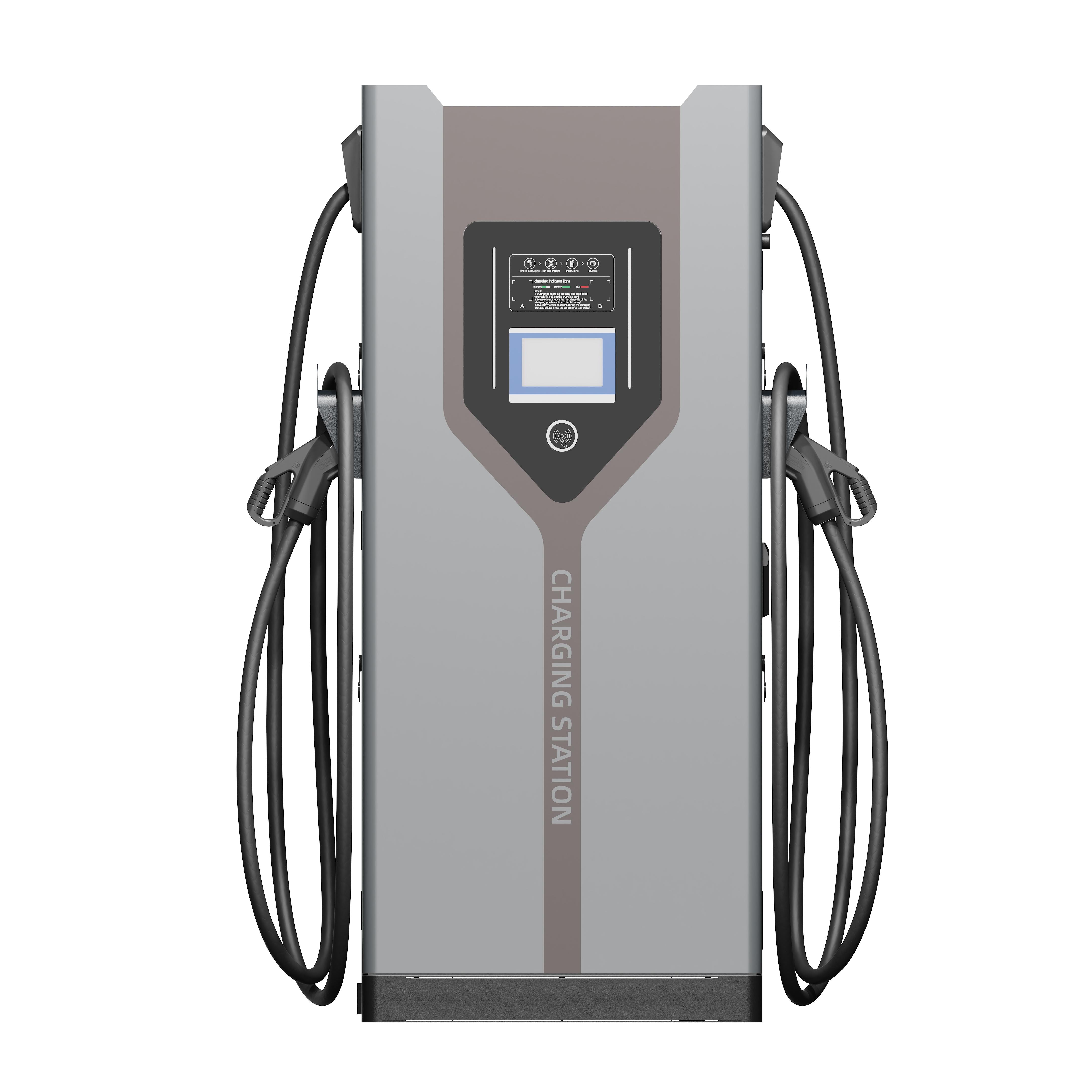
The Swift Pro 80–240 kW dual-gun DC fast charger: 97% efficiency, IP54 outdoor cabinet, dynamic power distribution between two guns.

Watch the Swift Pro in action: a 60-second walkthrough of the 80–240 kW dual-gun fast charger.
80–240 kW output with two independent guns — serve two vehicles simultaneously with dynamic allocation (e.g., 160 kW + 80 kW), doubling revenue per parking bay.
Modular rectifier design — start at 80 kW and add 20 kW modules as utilization grows; hot-swap replacement keeps uptime above 99%.
CCS1 / CCS2 / GB/T cable options with OCPP 1.6J / 2.0.1 backend integration — your choice of CSMS, payment and roaming platforms.
97% conversion efficiency and smart air cooling — lower energy losses and quieter operation for retail-adjacent sites.
IP54 outdoor rating with a compact footprint that installs on a standard concrete pad in under a day.
Full specifications and configuration options are on the Swift Pro dual-gun product page; the same platform is available as the Swift Pro high-power 60–240 kW fast charger for sites that need maximum continuous output. For mid-budget rollouts, the Speedy 60–240 kW modular DC charger shares the same architecture at a lower entry price, and the THUNDER 60–320 kW dual-standard station covers CCS2 + GB/T highway corridors. You can browse the complete range in our DC EV charger catalog.
Confirm your market's plug standard and any NACS transition plans.
Size power to dwell time × daily vehicles, not to the biggest number on the brochure.
Require dynamic power distribution if the cabinet has two guns.
Verify OCPP 1.6J/2.0.1 and test against your backend before shipment.
Check transformer headroom and demand-charge exposure with real interval data.
Insist on hot-swappable power modules and a local spare-parts kit.
Compare warranties on the modules (not just the cabinet) — 3 years minimum is standard.
Ask for uptime telemetry access; remote diagnostics save site visits.
Request third-party certificates: CE, UL/ETL (North America), ISO 15118 readiness.
Negotiate installation drawings and grid-application documents as part of the deal — a supplier who provides them saves you 4–8 weeks.
No. A 240 kW unit only earns its premium when (a) vehicles at your site accept ≥150 kW, (b) utilization is high enough that queue time matters, and (c) your grid connection can support the peak. For restaurants, hotels and urban retail, 80–120 kW dual-gun configurations usually deliver better return on investment because they serve two cars at once at a fraction of the cost.
The cabinet itself installs in one day on a prepared pad. Add 2–6 weeks for utility approval, transformer work (if needed) and commissioning. Sites with existing 400 A+ three-phase service and short trench runs are the fast cases.
With a modular platform like the Swift Pro series, yes — power modules are added inside the same cabinet as your utilization grows. With split charging stacks, expansion happens at the power cabinet, so dispensers stay untouched. Avoid non-modular sealed cabinets if growth is likely.
Modern well-designed DC cabinets run 95–97% peak conversion efficiency. Over a site serving 100 MWh per year, the difference between 93% and 97% is roughly 4,300 kWh — real money at commercial tariffs, and less heat for the cooling system to fight.
Not always — but if demand charges exceed ~$15/kW or your transformer is undersized, a battery buffer usually pays back in 4–7 years. See our guide to battery energy storage for commercial buildings for the payback math.
Ready to spec your site? Send us your location, grid capacity and target vehicles, and the HMHipech commercial charging team will return a sizing recommendation and quotation within 48 hours.